

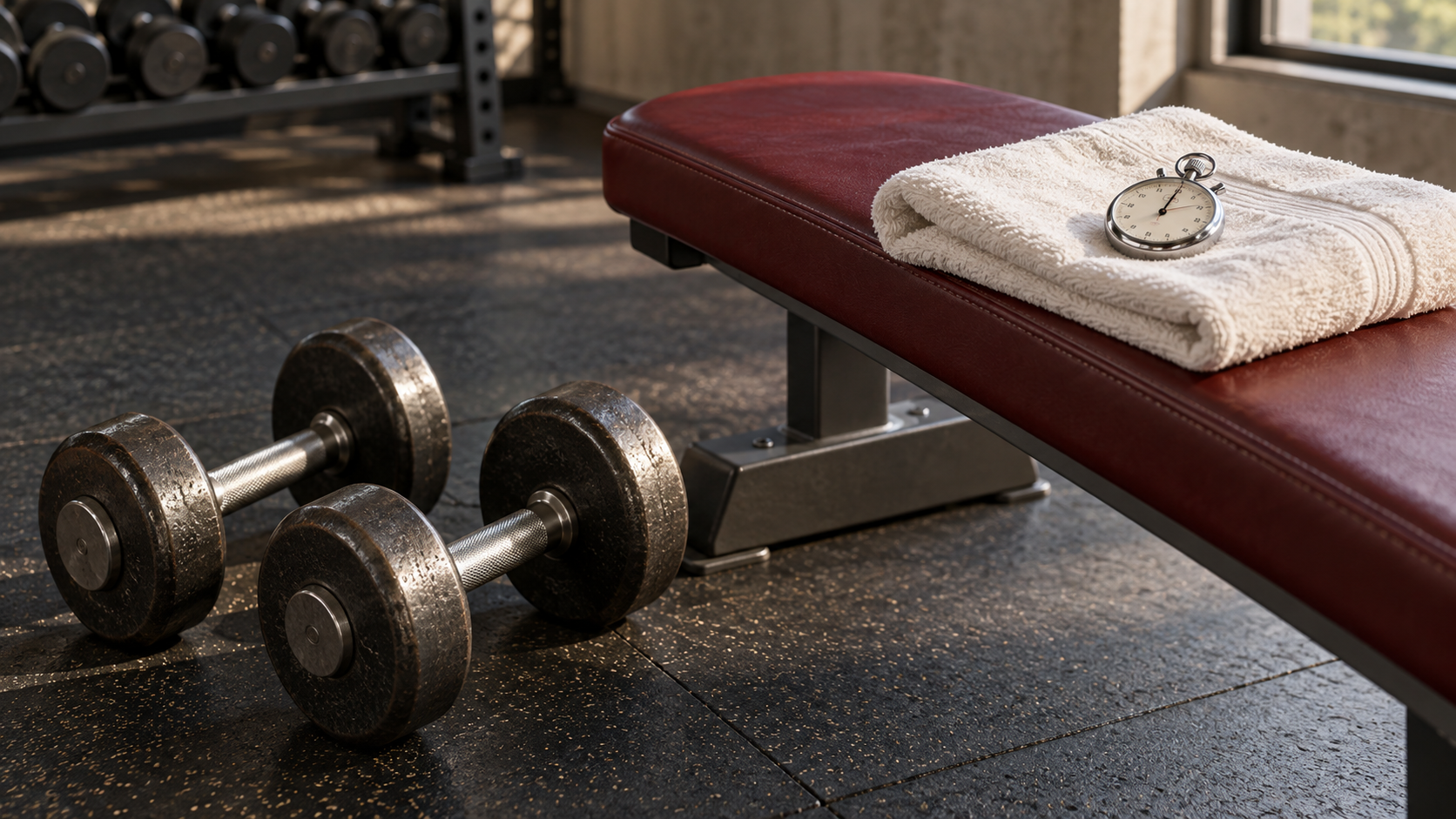
A minute can feel surprisingly long when you are sitting on a gym bench and somebody is waiting for the weights. It can also feel too short when the timer sounds and your legs still feel unready. That tension sits behind the question of how long to rest between sets: enough recovery to do the next set well, without turning a short workout into the rest of the afternoon.
For ordinary muscle-building work, around two minutes is a reasonable starting point. Demanding heavy sets may warrant three to five minutes; a less demanding set of curls may work with one to two. These are practical ranges to adjust, rather than durations research has established as uniquely best. The next set, and the purpose of the workout, should help decide whether the pause was long enough.
What the pause is buying you
Rest changes how much work you can perform when you pick the weights up again. A short break may leave the next set harder to complete, even when the weight has not changed. That matters if your aim was several demanding sets with a particular load and repetition range.
But doing more repetitions today and growing more muscle over the next few months are different outcomes. The first can help explain the second; it cannot substitute for measuring it. Much of the argument about rest periods comes from moving between those outcomes without noticing.
One randomized trial published in 2016 makes the longer-term question concrete. Twenty-one young men with resistance-training experience followed an eight-week program using either one-minute or three-minute rests. The three-minute group gained more strength in the squat and bench press, and more muscle thickness at the front of the thigh.
The advantages were specific. A triceps difference did not reach the usual threshold for statistical significance. Twenty-one trained men following one program also leave plenty of uncertainty about other lifters and exercises. Three minutes worked better for some outcomes in this comparison; the trial did not identify a universal optimum.
How long to rest between sets for muscle growth?
The broader evidence is more cautious. A 2024 review with Bayesian meta-analysis brought together nine studies. Its findings suggested a small muscle-growth advantage to resting longer than 60 seconds, with uncertainty about additional benefits beyond 90 seconds.
That last finding is easy to turn into a rule the evidence does not support. Uncertainty about extra benefit is not a demonstration that recovery stops being useful at a minute and a half. The studies were short, mostly involved younger untrained participants, and used different exercises and measures of muscle size.
There is room for a longer pause to help you complete a difficult set without a reliable estimate of how much extra muscle that pause will produce. A practical decision at the bench does not need to wait for a precise growth forecast.
Why the newest guidelines leave room for judgment
The American College of Sports Medicine’s 2026 position stand is an overview of reviews. It judged the evidence insufficient to determine how rest intervals influence hypertrophy, the technical term for muscle growth. Its overall strength comparison also did not identify a clear effect of longer versus shorter rests.
The earlier trial and the broader guidance need to be read together. An experiment asks what happened under one program; a review weighs how consistently findings travel across studies. The ACSM overview searched the literature in October 2024, but its listed hypertrophy-rest references do not include the Singer meta-analysis above. The later publication date alone cannot tell us which earlier findings were incorporated or why the judgments differ.
How long to rest between sets for strength?
For strength, an earlier systematic review was more favorable toward rests longer than two minutes in trained lifters, while finding shorter rests workable for beginners. Read alongside the newer overview, it supports keeping the recommendation conditional on the person and task, rather than promising that longer always wins.
Heavy work can still give you a good reason to rest longer: the shorter pause may interfere with the sets you planned. That is a decision about performing the work. Predicting an extra amount of strength or muscle from the longer pause requires a stronger claim than the evidence can consistently support.
A hard-feeling workout is not a growth measurement
Short rests can make a workout feel relentless. That sensation is sometimes sold as evidence of a superior muscle-building signal, especially when it comes with a temporary rise in circulating hormones.
A small 2016 study of 16 men compared one-minute and five-minute rests during leg exercise. The short-rest group had a larger acute testosterone response, yet the early muscle protein synthesis response was greater with the longer break. At 24 to 28 hours, the protein synthesis rates were indistinguishable between groups.
The study measured an early physiological response, so it cannot settle the months-long growth question. It does show why a temporary hormone rise is an unreliable shortcut to the answer. Feeling that you barely stopped moving is another shortcut: it tells you something about the experience of the workout, while leaving the adaptation question open.
Sapien’s discussion of concentric and eccentric exercise makes a related distinction: a training sensation or a plausible mechanism needs to be connected to the outcome actually measured.
Choosing how long to rest between sets in your own session
Take an exercise you already know and use the starting ranges above as a reference. Keep track of the load, repetitions and how demanding the set was, along with the pause. You want enough context to tell whether changing the break helped, rather than comparing two quite different workouts.
Suppose you planned three sets in the same repetition range. On the second set, you fall well short despite similar effort and unchanged load. Extra rest is one adjustment to try. You might also need to reconsider the load or how close to failure you took the first set. Some decline across hard sets is ordinary; a missed repetition is not a diagnosis of inadequate recovery.
Keep a simple record of the rest you actually took. If a longer pause makes the intended sets more repeatable, that is useful feedback. It does not prove you have found your personal maximum-growth interval. You are checking whether a small programming change helps you perform the session you meant to perform.
Time also matters when choosing how long to rest between sets. Longer rests may be sensible on a heavy squat without being necessary between every easier exercise. If the session regularly overruns, review the whole plan rather than automatically squeezing every break. You can prioritize the exercises that matter most or discuss a more manageable structure with a qualified coach.
A faster heartbeat settling down can be reassuring, but it is not a standardized test that the working muscles are ready. Use the demands of the lift and ordinary safe exercise practice; there is no heart-rate threshold in the studies above that guarantees readiness.
The Sapien interpretation: rest should serve the next effort
The stopwatch creates an appealing kind of certainty. Sixty seconds is exact. “Enough recovery for the next set” requires judgment, and judgment feels less satisfying when an app could simply beep.
But precision in the timer is different from precision in the evidence. The useful role of a rest period is to help you deliver the kind of training you intended within a session you can realistically maintain. Sometimes that means waiting longer. Sometimes the current break is already doing its job.
You do not have to spend the pause proving that you are working hard. Put the weights down, let the timer provide a reference, and return to the set with a clear purpose. Over several sessions, the record of what you can do is more useful than the guilt of sitting still for another minute.
Read next: Active Recovery for Muscle Soreness: Does Moving Help You Recover? Between-set recovery and next-day soreness ask different questions. That article examines what gentle movement can actually change after the workout is over.
References
- Schoenfeld BJ and colleagues. Longer interset rest periods in resistance-trained men. Journal of Strength and Conditioning Research. 2016;30(7):1805-1812. doi:10.1519/JSC.0000000000001272.
- Singer A and colleagues. Give it a rest: Bayesian meta-analysis of rest intervals and hypertrophy. Frontiers in Sports and Active Living. 2024;6:1429789.
- American College of Sports Medicine. 2026 resistance-training prescription position stand. Medicine & Science in Sports & Exercise. 2026;58(4):851-872. Source of the opening quotation.
- Grgic J, Schoenfeld BJ, Skrepnik M, Davies TB, Mikulic P. Rest-interval duration and muscular strength: systematic review. Sports Medicine. 2018;48:137-151. Published online 2017.
- McKendry J and colleagues. Short inter-set rest and the acute muscle protein synthesis response. Experimental Physiology. 2016;101(7):866-882. doi:10.1113/EP085647.
