

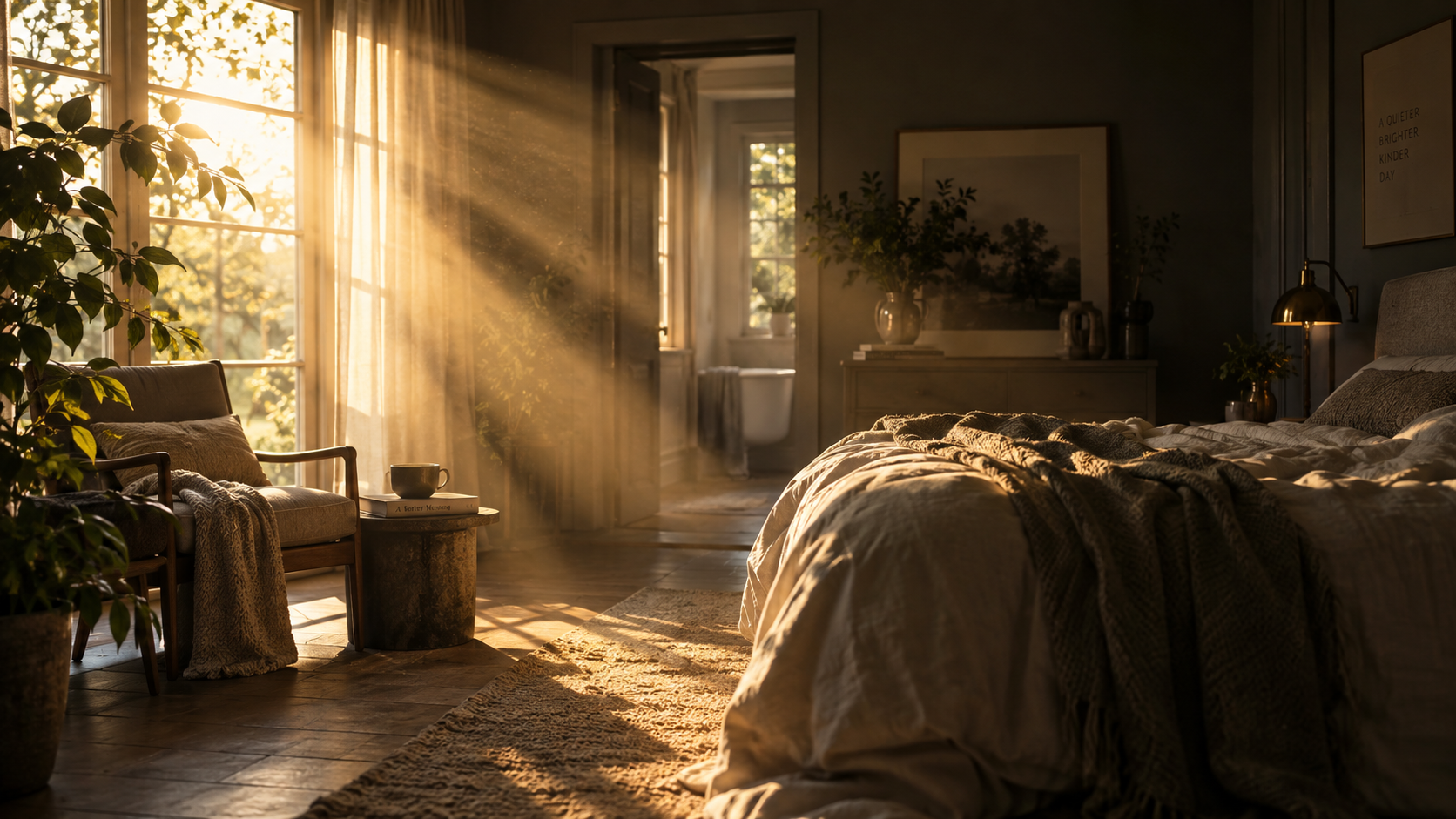
“The sunshine is life and health to me.”
John Ruskin, Hortus Inclusus
Step outside soon after waking and the light can feel almost incidental. You may be taking out the trash, walking to the car, or standing on a porch with coffee. To the circadian system, though, that brightness is information: morning has arrived.
Morning sunlight is one of the strongest environmental signals for the roughly 24-hour system that helps coordinate sleep, alertness, hormone timing, body temperature and other daily rhythms. Modern life often gives that system an unusual pattern: relatively dim mornings indoors followed by bright artificial evenings.
The intervention is wonderfully low-tech. The claims around it are not always modest. Morning sunlight is credited with “balancing hormones,” fixing metabolism, raising vitamin D, curing insomnia and improving mood all at once. Some of those ideas have a scientific basis. Others ask the evidence to do too much.
Morning sunlight is a timing signal, not magic
Your eyes do more than create vision. Specialized retinal cells containing the light-sensitive protein melanopsin send information about environmental light to brain regions involved in circadian timing, including the suprachiasmatic nucleus, often called the body’s master clock.
The practical consequence is straightforward: light exposure tells your circadian system what time it is. Light early in the biological day tends to shift the clock earlier, while light later in the evening tends to shift it later.
An international expert consensus published in PLOS Biology recommends strong light exposure during the day, much lower light in the three hours before bedtime, and an environment that is as dark as practical during sleep. The authors specifically note that daylight is preferable when available.
The goal is not simply to collect a certain amount of light. The circadian system reads a pattern: bright days and dark nights. A dim office at noon followed by a luminous screen at midnight weakens that contrast. It also fits a theme we explored in the modern mind and our ancestral roots: modern environments can drift away from the signals human biology expects.
What the evidence says about sleep, alertness, and mood
1. Sleep timing: the strongest case
The best-supported benefit of morning light is circadian alignment. A 2019 systematic review found a broad pattern: brighter morning light was associated with earlier sleep timing and, in some studies, better subjective sleep outcomes. A later meta-analysis of light therapy for insomnia also found that morning light can advance sleep-wake timing, although studies varied in how light was delivered.
A 2025 study of 1,762 adults adds a useful real-world signal. Every additional 30 minutes of sunlight before 10 a.m. was associated with an earlier midpoint of sleep by about 23 minutes and with a modest improvement in overall sleep-quality score. The study did not find significant improvements in total sleep time, sleep latency, or sleep efficiency.
That distinction keeps the claim in proportion. Morning light may help organize when your body expects sleep, but it is not a sedative. It cannot replace missing sleep, and it cannot solve every reason someone struggles to sleep.
2. Alertness: real, but not a caffeine replacement
Daytime light can promote alertness through circadian and more immediate nonvisual pathways. In practice, a bright outdoor environment after waking often feels more activating than a dim bedroom or windowless commute.
“Boosts energy” is a slippery way to describe that effect. Light can reinforce wakefulness and circadian timing, but it cannot manufacture sleep you did not get. Its advantage is simpler: it can fit into coffee on a porch, a short walk, or part of a commute without becoming another elaborate wellness ritual.
3. Mood: promising, but context matters
Bright-light therapy has established uses in selected mood and circadian disorders, which is one reason ordinary morning daylight has acquired a reputation as a general mood enhancer. In healthy adults, however, a systematic review of everyday light exposure found limited and sometimes conflicting associations with mood.
There is also a real-world confounder: going outdoors changes more than light. It may add movement, greenery, distance vision, fresh air, or a brief interruption in stress. We explored one part of that environment in The Color of Calm.
Morning sunlight, vitamin D, and the myths worth clearing up
Morning sunlight articles often jump from circadian rhythm to vitamin D. These are both related to sunlight, but they are not the same mechanism.
The circadian effect is driven by light entering the eyes. Vitamin D synthesis is driven by UVB radiation reaching the skin. You do not need to stare directly at the sun for either purpose.
The National Institutes of Health notes that vitamin D production from sun exposure varies with season, time of day, latitude, cloud cover, skin pigmentation, age, clothing, and other factors. UVB also does not pass effectively through ordinary window glass, so sitting beside a sunny window may provide a strong light signal to your eyes while contributing essentially nothing to vitamin D production.
There is an important irony here. Early morning can be excellent for circadian light exposure while being a relatively inefficient time for vitamin D synthesis because UVB intensity is generally lower than around midday. Morning light is still useful. It is simply serving a different biological purpose.
And more sun is not automatically better. The CDC emphasizes that excessive UV exposure damages skin and increases skin-cancer risk. A circadian-health habit should not become an excuse to seek a tan or sunburn.
| Claim | What the evidence supports |
|---|---|
| Morning light helps set the body clock | Well supported. Light timing is a major circadian cue. |
| Morning light can improve sleep | Reasonable, with nuance. Evidence is strongest for sleep timing and circadian alignment. |
| Morning sun boosts mood | Plausible but less certain in healthy adults. |
| Morning sunlight is the best way to make vitamin D | Misleading. Vitamin D depends on UVB exposure and many individual and environmental factors. |
| You should look directly at the sun | No. Normal outdoor light exposure is sufficient. |
How to use morning light without overcomplicating it
There is no universally proven “10-minute rule” that applies to every person, latitude, season, weather condition, and chronotype. Outdoor light intensity changes dramatically, and individual circadian sensitivity varies.
A more useful framework is behavioral:
- Get outside relatively soon after waking. For people on a conventional daytime schedule, early-day light is the most relevant signal for anchoring the clock earlier.
- Let the environment be bright, not your eyeballs. Face the general outdoor environment. Never stare directly at the sun.
- Make it repeatable. A habit you can keep most days is more valuable than chasing a perfect protocol once a week.
- Pair bright mornings with dimmer evenings. The circadian system responds to the full light-dark pattern.
- Protect your skin when UV exposure warrants it. Morning light and sensible sun protection are compatible goals.
If mornings are rushed, the solution does not need to be picturesque. Step outside while coffee brews. Walk around the block. Spend part of the commute outdoors. And if you are trying to attach healthy behaviors to routines you already have, our guide to the benefits of walking after meals uses the same idea in a different context.
Shift workers, people with circadian-rhythm disorders, and anyone using bright-light therapy for a medical or psychiatric condition are different cases. For them, light timing can function as treatment, and the wrong timing can push the clock in the wrong direction.
The larger lesson: design the day, not just the morning
Part of the appeal of morning sunlight is that there is almost nothing to buy or optimize. You step outside and one of the oldest environmental signals in human biology is simply there.
The deeper lesson is not that sunrise is a miracle drug. It is that the body notices patterns. Brightness and darkness, movement and stillness, meals and fasting, work and rest all help organize physiology across the day.
Morning light is one of the clearest examples. Its strongest case is as a cue, not a cure-all: a reliable way of telling the circadian system, this is morning.
Frequently asked questions
How long should I get morning sunlight?
There is no single evidence-based duration that fits everyone. Light intensity, cloud cover, season, latitude, timing, and individual sensitivity all matter. A consistent period outdoors soon after waking is more defensible than a rigid universal minute count.
Does morning sunlight work through a window?
Bright light through a window can still provide a circadian signal, although outdoor light is usually much brighter. For vitamin D, NIH notes that UVB does not penetrate ordinary glass well enough to drive meaningful skin production.
Do I need to look at the sun?
No. Never stare directly at the sun. Your circadian system responds to ambient light reaching the eyes; direct solar viewing is unnecessary and can injure the retina.
Is morning sunlight better than a light box?
For most healthy people, natural outdoor light is simple and free. Therapeutic light boxes can be useful in certain circadian and mood disorders, particularly when outdoor light is limited, but their clinical use depends on timing, intensity, and the condition being treated.
References
- de Menezes-Júnior LAA, et al. The role of sunlight in sleep regulation: analysis of morning, evening and late exposure. BMC Public Health. 2025;25:3362. doi:10.1186/s12889-025-24618-8.
- Brown TM, et al. Recommendations for daytime, evening, and nighttime indoor light exposure to best support physiology, sleep, and wakefulness in healthy adults. PLOS Biology. 2022;20(3):e3001571.
- A systematic review of the amount and timing of light in association with objective and subjective sleep outcomes in community-dwelling adults. Sleep Health. 2019;5(1):31-48.
- Böhmer MN, et al. Are we still in the dark? A systematic review on personal daily light exposure, sleep-wake rhythm, and mood in healthy adults from the general population. Sleep Health. 2021;7(5):610-630.
- Light therapy in insomnia disorder: a systematic review and meta-analysis. Journal of Sleep Research. 2023.
- National Institutes of Health Office of Dietary Supplements. Vitamin D: Health Professional Fact Sheet.
- Centers for Disease Control and Prevention. Reducing Risk for Skin Cancer. Updated June 17, 2026.

1 thought on “Morning Sunlight: Why the First Light of Day Matters for Sleep, Mood, and Your Body Clock”
Pingback: Strength Training for Longevity: Why Muscle Matters