

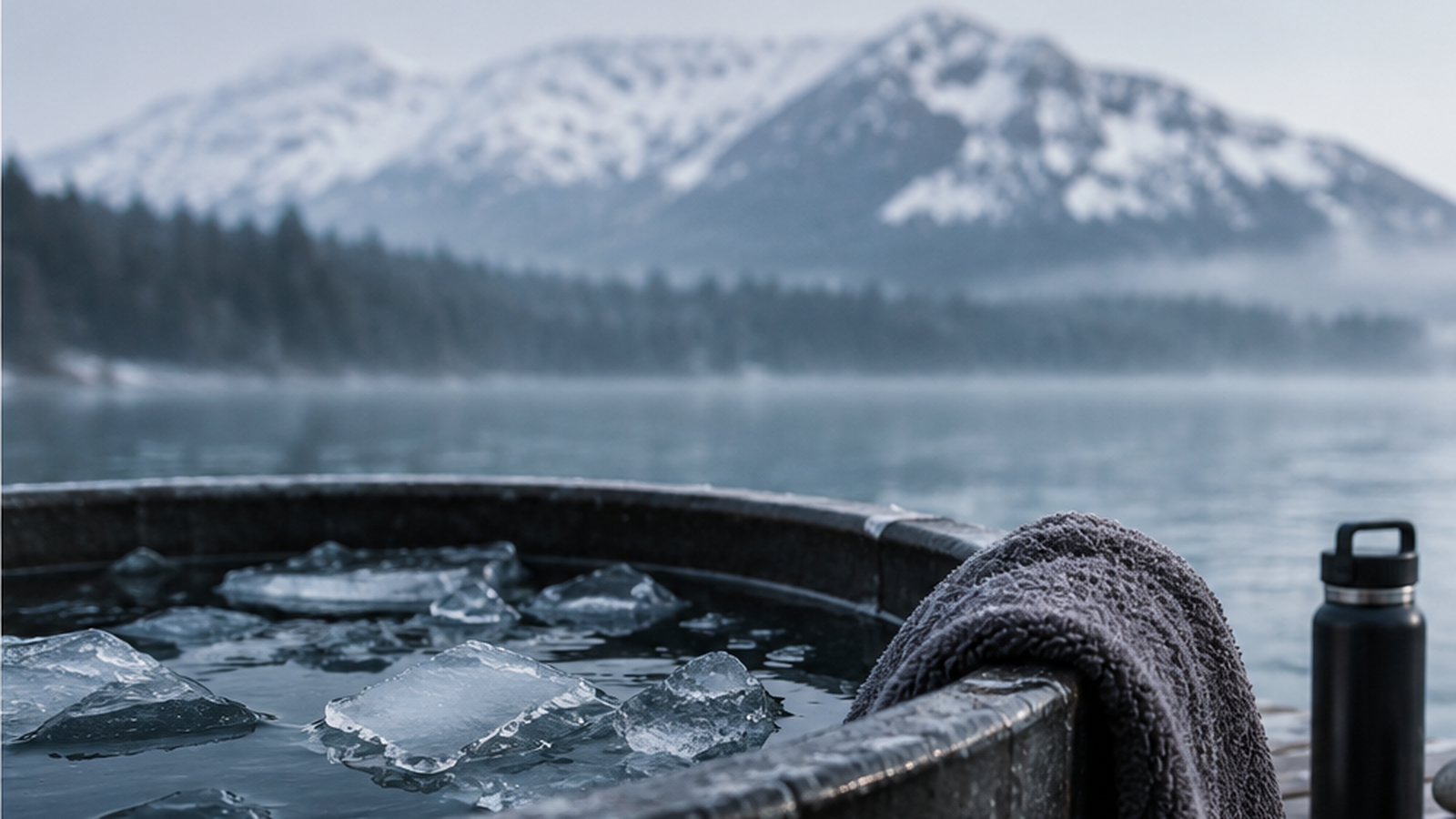
“Cold water immersion attenuated long term gains in muscle mass and strength.”
– Roberts et al., The Journal of Physiology, 2015
The cold plunge after workout ritual has become one of the most visible recovery practices in fitness. The appeal is obvious: cold water can make you feel less sore, less overheated, and more ready to train again. But recovery and adaptation are not the same thing.
That distinction matters because training works by creating stress and then adapting to it. If a recovery method reduces discomfort today but also weakens part of the signal that helps muscle adapt over weeks and months, whether it is helpful depends on the goal.
The useful question is not “Are cold plunges good or bad?” It is: when does cold water improve short-term readiness, and when might it interfere with the adaptation you are trying to build?
What a Cold Plunge After Workout Actually Does
Cold-water immersion rapidly cools the skin and superficial tissues, causes peripheral vasoconstriction, and changes how the nervous system perceives temperature and discomfort. After exercise, these effects can alter soreness, perceived recovery, and some biochemical markers associated with exercise-induced muscle damage.
The clearest benefit is subjective. A systematic review and meta-analysis of 44 trials found that cold-water immersion reduced muscle soreness compared with passive recovery across a range of protocols. A separate 2023 meta-analysis also found that cold-water immersion performed well for soreness relative to several other recovery methods.
That does not mean every marker of recovery improves in parallel. A newer 2026 systematic review and meta-analysis found no meaningful overall improvement in maximal isometric strength after acute cold-water immersion, while immediate explosive performance could worsen. Soreness improved, but the certainty of several biochemical findings was low.
In other words, feeling better and performing better are related, but they are not interchangeable.
Cold Plunge Benefits Are Strongest for Short-Term Recovery
If your priority is being ready again soon, cold water becomes more attractive.
A systematic review of 68 studies found that cold-water immersion could improve some aspects of recovery after exercise, including endurance performance in the short term and later recovery of strength and jump performance. The benefits varied with the type of exercise, timing, and testing conditions.
This helps explain why cold-water immersion can make sense in tournaments, stage races, multi-event competitions, preseason camps, or periods when athletes have to perform again before full biological recovery is possible.
In that setting, you are not necessarily trying to maximize the training signal from one isolated session. You may be trying to preserve performance across several closely spaced sessions.
The Catch: Recovery and Adaptation Are Different Goals
Exercise produces fatigue, but it also produces signals that tell the body to adapt. Resistance training, for example, triggers molecular pathways involved in muscle protein synthesis, remodeling, and hypertrophy.
That creates the central tension in the cold-plunge literature. If you repeatedly cool muscle immediately after lifting, you may change some of those post-exercise signals.
One influential randomized resistance-training study found that regular post-exercise cold-water immersion reduced acute anabolic signaling and attenuated long-term gains in muscle mass and strength compared with active recovery. Later work found a similar pattern for muscle fiber hypertrophy even when strength differences were less clear.
A systematic review and meta-analysis of chronic cold-water immersion concluded that regular use alongside resistance training was associated with smaller improvements in strength, while endurance adaptations were not clearly impaired.
A more focused meta-analysis of resistance training also found a small attenuation of strength gains, although whole-body immersion analyses were less definitive than single-limb studies.
Cold Plunge After Workout for Muscle Growth
If your main goal is hypertrophy, the safest evidence-based interpretation is simple: do not make immediate post-lifting cold-water immersion a default habit.
That does not mean one cold plunge ruins a workout. The concern comes from repeated use immediately after resistance training over time.
For someone following a program built around strength training for longevity, preserving the adaptive signal generally matters more than eliminating every trace of soreness. Mild soreness is not proof of a good workout, but neither is it something that always needs to be erased.
If you enjoy cold exposure for reasons unrelated to recovery, separating it from your lifting session by several hours is a reasonable practical compromise, although research has not identified one perfect universal delay.
Cold Plunge After Workout for Endurance Training
For endurance athletes, a cold plunge after workout can serve a different purpose.
Cold-water immersion can be particularly useful when exercise happens in the heat or when rapid turnaround matters. Cooling can lower thermal strain and may help restore perceived readiness after long or intense endurance sessions.
Chronic evidence has not shown the same consistent concern about blunted aerobic adaptation that appears in resistance training. The 2021 meta-analysis found no clear negative effect of regular cold-water immersion on aerobic performance outcomes.
That does not prove cold water enhances endurance adaptation. It means the adaptation penalty seen with resistance training has not been demonstrated as consistently for endurance work.
What About Team Sports and Competition?
For team-sport athletes, a cold plunge after workout can make practical sense when recovering enough to play again matters more than maximizing adaptation from one session.
That is where cold-water immersion has one of its strongest practical arguments. A soccer player with another match in 48 hours, a basketball player in tournament play, or a runner in a stage event may value lower soreness and improved perceived recovery even if the long-term training question remains more complex.
A 2026 network meta-analysis covering 87 studies concluded that optimal cold-water strategies differ by exercise modality. Passive recovery appeared preferable when the goal was maximizing resistance-training strength adaptation, while moderate cold protocols offered possible recovery benefits in endurance settings. The authors also emphasized that evidence certainty was often low to moderate and that female athletes remained underrepresented.
The key is matching the tool to the objective.
How Cold Is Cold Enough?
Fitness culture often treats colder as better. The evidence does not support a competition for the lowest possible temperature.
A 2025 network meta-analysis found that protocols lasting roughly 10 to 15 minutes in water around 5°C to 15°C performed well for several recovery outcomes. Extremely cold water was not necessary to produce an effect.
That is important for both comfort and safety. Water cold enough to trigger gasping, panic, loss of coordination, or prolonged numbness is not automatically more therapeutic.
Cold exposure can also produce an abrupt cardiovascular response. People with cardiovascular disease, arrhythmias, uncontrolled blood pressure, fainting history, or other relevant medical conditions should discuss deliberate cold-water immersion with a clinician before treating it as a routine wellness practice.
When a Cold Plunge Makes the Most Sense
Instead of asking whether you “believe in” cold plunges, ask what you need from the next 24 to 48 hours.
- Closely spaced competition: potentially useful when soreness and rapid readiness matter.
- Endurance exercise in heat: potentially useful for cooling and short-term recovery.
- Team-sport tournament: reasonable when multiple performances matter more than adaptation from one training session.
- Hypertrophy-focused lifting: avoid making immediate immersion a routine after every session.
- General recreational exercise: optional. Sleep, nutrition, progressive training, and adequate recovery remain far more important.
The same principle applies to other recovery rituals. Sapien’s guide to sauna and health explores another popular temperature-based practice, but heat and cold should not be treated as mirror-image solutions.
Does Reducing Soreness Mean Better Recovery?
Not necessarily.
Soreness is a perception, not a direct measurement of muscle repair. Creatine kinase is a blood marker, not a complete measurement of recovery. Jump height is useful in some sports, but irrelevant to others.
When studies use different definitions of “recovery,” apparently conflicting results can all be true at the same time. One protocol may reduce soreness without restoring strength. Another may improve thermal comfort while leaving muscle damage unchanged.
This is why a single headline such as “cold plunges improve recovery” hides too much.
The Sapien Interpretation: Recovery Is Not Adaptation
The most useful way to think about a cold plunge after workout is as a tool for managing the short-term consequences of training, not as a universal way to make training more effective.
If tomorrow’s performance matters most, reducing soreness and thermal strain can be valuable. If long-term muscle growth is the priority, repeatedly suppressing parts of the post-exercise response may work against the goal.
Athletes have always had to balance these two needs. The body needs enough recovery to keep performing, but enough stress to keep adapting.
Cold water does not resolve that tradeoff. It simply gives you another lever to pull.
Bottom Line
A cold plunge after workout can reduce muscle soreness and may improve certain short-term recovery outcomes. It can be useful when competition, heat, or closely spaced sessions make rapid readiness important.
But regular immediate cold-water immersion after resistance training may attenuate some long-term strength and hypertrophy adaptations. That makes it a questionable default for people whose primary goal is building muscle.
The best use of cold is therefore situational. Recover when you need to recover. Adapt when you need to adapt. Do not assume those goals are always identical.
References
- Batista NP, et al. What Parameters Influence the Effect of Cold-Water Immersion on Muscle Soreness? 2023.
- Moore E, et al. Cold-Water Immersion Compared with Other Recovery Modalities. 2023.
- Malta ES, et al. Regular Cold-Water Immersion and Training Adaptations. 2021.
- Grgic J. Post-Exercise Cold-Water Immersion and Strength Gains. 2023.
- Roberts LA, et al. Cold-Water Immersion, Anabolic Signaling and Strength Training. 2015.
- Yu T, et al. Cold-Water Immersion Protocol Optimization Across Exercise Modalities. 2026.
