

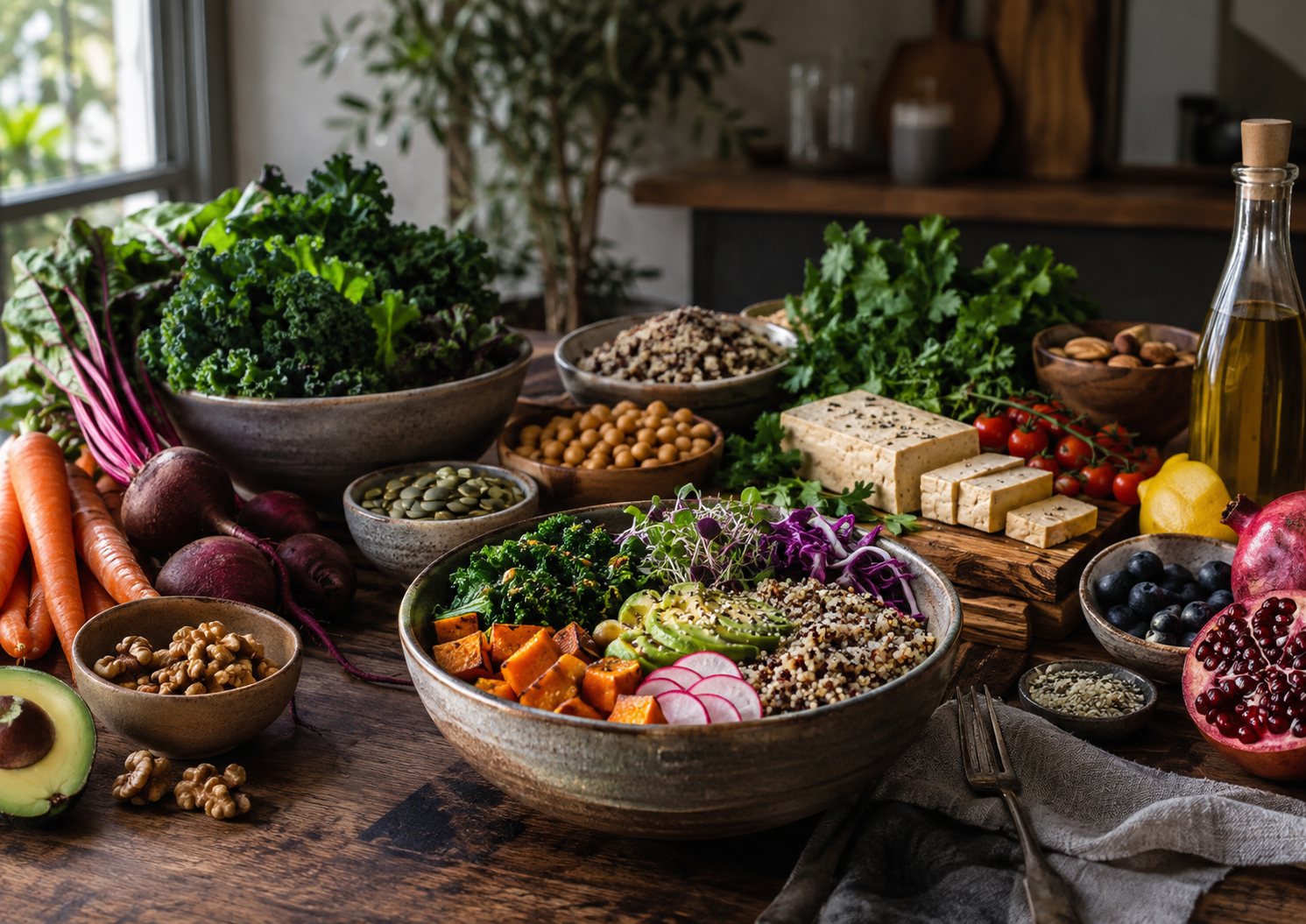
“Eat food. Not too much. Mostly plants.”
– Michael Pollan, In Defense of Food, 2008
Sports nutrition debates have a way of turning food into identity. A plant based diet for athletes is often framed at one extreme as a performance advantage and at the other as something that must compromise strength, recovery, or muscle growth.
The evidence supports a less dramatic conclusion: a well-planned plant-based diet is a legitimate performance diet. Current comparative research does not show that animal foods are required for strength, hypertrophy, recovery, or endurance. Some analyses even suggest a possible aerobic advantage, although that finding is not strong enough to call plant-based eating universally superior.
The strongest case is therefore not that plant foods are magical. It is that the assumed performance penalty becomes hard to defend once energy, protein, carbohydrate and key micronutrients are planned well.
Athletes make that planning unusually visible. High training loads expose weak points quickly, which is why their diets can teach the rest of us something useful about turning a plant-forward pattern into an eating plan that actually works day after day.
Can a Plant Based Diet for Athletes Support Performance?
Yes. At this point, the more useful question is not whether plant-based eating can support performance, but whether the diet is built well enough to support the work an athlete is asking the body to do.
A 2023 systematic review comparing vegetarian and omnivorous athletes found no meaningful differences in VO2 max, muscle power, sprint performance, or body composition. Vegetarian athletes generally consumed more carbohydrate and less protein, yet their measured performance was not worse.
A separate systematic review and meta-analysis of plant-based diets and athletic performance found a moderate positive effect on aerobic performance and no significant impairment in strength or power. The number of included studies was still limited, so the aerobic finding should be treated as promising rather than definitive.
A 2024 systematic review reached a similarly favorable conclusion: plant-based diets did not harm athletic performance or body composition, and some studies reported improvements in outcomes such as maximal oxygen consumption, relative strength, and countermovement-jump performance.
Strength and Muscle Adaptation
Strength outcomes have become particularly reassuring. A 2025 systematic review and meta-analysis of randomized trials found no significant difference between plant-based and omnivorous diets in upper-body, lower-body, or overall muscular strength. More recently, a 2026 controlled resistance-training study found that participants following vegan and omnivorous diets both improved strength, with no evidence that the vegan diet compromised training adaptation.
That moves the conversation beyond simply defending plant-based diets from the claim that they cannot work. Plant-based eating can fuel serious training and meaningful adaptation. The evidence does not show that it is universally superior to an omnivorous diet, but it does make it a scientifically credible performance strategy rather than a nutritional compromise by default.
Protein Is Usually the First Question
Protein is usually the first objection raised about a plant based diet for athletes, and it is also where the discussion tends to become unnecessarily binary.
Plant proteins do vary in digestibility and essential amino acid content. Some sources contain less leucine or lower proportions of one or more essential amino acids than common animal proteins. That matters, but it does not make plant protein ineffective. It turns protein into a planning problem involving total intake, source selection and variety.
One of the most useful trials was published in Sports Medicine in 2021. Habitual vegans and omnivores followed protein-matched diets while completing resistance training. When protein intake was high enough, both groups gained muscle and strength similarly.
A 2023 randomized trial pushed the question further. Young adults completed 10 weeks of high-volume resistance training while eating either a high-protein vegan or omnivorous diet. Both diets provided roughly 2 grams of protein per kilogram of body weight per day. Muscle protein synthesis, lean mass gains, thigh muscle volume, and strength improved similarly in both groups.
What the Protein Evidence Means in Practice
For most people, the practical lesson is not that everyone needs 2 grams per kilogram. It is that once protein needs are met, the source of that protein may matter less than many people assume.
Recovery research points in the same direction. A 2025 systematic review of plant proteins after resistance exercise found that appropriately dosed plant-protein blends can stimulate muscle protein synthesis at levels comparable with whey. The review also noted that dose, leucine content, and protein formulation matter, which turns protein quality into a planning problem rather than an argument against the diet itself.
Useful plant-based protein foods include soy foods, lentils, beans, peas, seitan, mycoprotein, nuts, seeds, whole grains, and plant protein powders when convenient. People who are also interested in preserving muscle with age may find our guide to strength training for longevity useful as well.
Carbohydrates Are a Strength, Not a Side Note
Plant-based eating often makes carbohydrate intake easier because grains, fruit, legumes, and starchy vegetables are naturally prominent. For athletes, that can be useful. Carbohydrate is a major fuel source for moderate- and high-intensity exercise, and adequate intake helps restore muscle glycogen between training sessions.
This does not mean that every athlete needs a very high-carbohydrate diet. Needs vary with sport, training duration, intensity, and total workload. A powerlifter training four hours per week and a cyclist training 18 hours per week do not have the same fueling demands.
The broader lesson is simple: carbohydrates are not nutritional clutter in an athlete’s diet. For many training demands, they are part of the performance strategy.
Why Plant-Based Eating Can Be a Strong Athlete Diet
A well-built plant-based diet naturally centers many foods that are useful to athletes: grains, potatoes, fruit, legumes, soy foods, nuts, seeds, and vegetables. That can make it easier to build meals rich in carbohydrate while also supplying fiber, potassium, magnesium, folate, vitamin C, and a wide range of plant compounds.
That broader nutritional pattern may matter beyond the next workout. An umbrella review of plant-based diets and cardiometabolic health found improvements in measures including LDL cholesterol, fasting glucose, body weight, and waist circumference across the underlying meta-analyses. Those data come from general adult populations rather than competitive athletes, so they should not be presented as a performance effect. They do show that a performance diet can also fit inside a health-promoting dietary pattern.
For an athlete, the attraction is therefore not one magic nutrient. It is the combination of abundant carbohydrate, multiple workable protein sources, high food variety, and the possibility of supporting long-term health while still meeting training demands.
How to Build a Plant Based Diet for Athletes That Performs
The common problems in plant-based sports nutrition are usually practical rather than mysterious. Athletes run into trouble when total intake is too low, food choices become too narrow, or restriction creates gaps that the diet itself does not require.
1. Not eating enough energy
Many minimally processed plant foods are filling relative to their calorie content. That is useful for some people, but it can become a problem when training volume is high. An athlete who needs substantial energy may struggle if every meal is built around enormous portions of vegetables, beans, and high-fiber foods without enough calorie-dense options.
2. Assuming every plant-based food is automatically nutritious
A vegan label says what a food excludes. It does not tell you whether that food provides enough protein, fiber, vitamins, minerals, or energy for your needs.
3. Protein intake that is technically adequate but poorly distributed
Someone can reach a reasonable daily protein total while eating very little protein at breakfast and lunch, then trying to make up the difference at dinner. A more practical approach is to include a meaningful protein source across several meals.
4. Too much fiber at the wrong time
Fiber is valuable for health, and Sapien has a full guide to dietary fiber. But very high fiber intake immediately before intense exercise can be uncomfortable. Athletes often adjust the amount and timing of high-fiber foods around competition or demanding sessions rather than avoiding fiber altogether.
Key Nutrients in a Plant Based Diet for Athletes
A plant-based diet can be nutritionally complete, but a few nutrients deserve deliberate planning.
Vitamin B12: People eating fully vegan diets need a reliable source from fortified foods or supplementation. This is one nutrient that should not be left to chance.
Iron: Plant foods provide non-heme iron, which the body absorbs less efficiently than heme iron. Legumes, tofu, seeds, whole grains, and leafy greens can contribute meaningful amounts. Pairing iron-rich plant foods with vitamin C can improve absorption. Athletes with symptoms of deficiency or known risk factors should discuss testing with a clinician rather than supplementing blindly.
Calcium and vitamin D: Fortified plant milks, calcium-set tofu, certain greens, and other fortified foods can help. Vitamin D intake and sun exposure vary widely, so individual assessment matters.
Zinc: Beans, whole grains, nuts, and seeds contribute zinc, but bioavailability can be lower in plant-heavy diets.
Iodine: People who avoid seafood and dairy and also do not use iodized salt can end up with low iodine intake.
Omega-3 fats: Flax, chia, hemp, and walnuts provide alpha-linolenic acid. Algae-derived EPA and DHA are options for people who want a direct plant-based source of long-chain omega-3s.
Creatine: Animal foods provide most dietary creatine, so vegetarians and vegans generally consume less of it. Supplementation can increase muscle creatine stores, and it is one of the better-supported performance supplements for repeated high-intensity exercise and resistance training.
A Practical Plant Based Diet for Athletes
One of the newest additions to the sports nutrition literature is the Vegan/Vegetarian Athlete’s Plate, published in The Journal of Nutrition in 2026. Researchers developed 120 example meals for different body sizes and training loads, then tested whether the meals met sports nutrition targets.
The model successfully met energy and macronutrient guidelines across training loads. The areas that still required more attention were familiar ones: iron, zinc, vitamin B12, and occasionally excessive fiber. Athletes who used the plate found it helpful for building meals that matched their training demands.
The useful idea is simple. A performance-oriented plant-based meal should usually do three things at once:
- Provide enough carbohydrate for the training demand.
- Include a substantial protein source, such as tofu, tempeh, seitan, beans, lentils, soy milk, mycoprotein, or a plant protein supplement.
- Supply enough total energy, with fats, starches, grains, nuts, seeds, or other calorie-dense foods added when needed.
Vegetables and fruit still matter, but an athlete’s plate needs more than micronutrients alone. Training requires fuel.
Athlete Voices: How Plant-Based Eating Works in Real Life
Controlled studies can tell us whether a diet can support performance under defined conditions. Athletes show a different part of the picture: what that diet looks like when it has to survive years of training, appetite, travel, routine and ordinary food choices. Their experiences cannot establish cause and effect, but they can show how the principles are implemented outside a trial.
1) Torre Washington: Vegan Bodybuilding Was the Starting Point, Not the Conversion
For vegan bodybuilder Torre Washington (@torre.washington), plant-based eating did not begin as a performance experiment. He was raised vegetarian and has been vegan since 1998. His interest in bodybuilding started with a much less nutritional idea: he wanted to look like a superhero and discovered Arnold Schwarzenegger.
Washington says he was already vegan when he decided to compete, describing bodybuilding as a bucket-list challenge rather than something that caused him to change his diet. That makes his experience different from athletes who switch to plant-based eating later and then try to attribute changes in performance to the diet itself.
When asked about the advantages and limitations, Washington said he personally sees no disadvantages and feels that he has more energy eating this way. That is his individual experience, not proof that a vegan diet universally increases energy. What is notable is that his experience is no longer difficult to reconcile with the research. Controlled studies now show that well-planned plant-based diets can support strength, hypertrophy, recovery, and endurance without an inherent performance penalty.
Practical Lessons From a Vegan Bodybuilder
His practical advice is notably simple: eat a variety of foods and eat enough calories. That lines up closely with one of the most important findings from the sports-nutrition literature. Plant-based eating becomes much harder when athletes unintentionally under-eat because high-fiber foods are filling, or when they rely on a narrow set of foods that makes protein and micronutrient planning more difficult.
Washington also does not frame plant-based eating as an all-or-nothing identity test. Asked what he would tell someone interested in reducing animal foods without eliminating them completely, his answer was, “Everyone has their own journey.” That perspective fits the broader evidence: a person does not need to adopt a fully vegan diet to benefit from eating more legumes, whole grains, vegetables, fruit, nuts, seeds, and soy foods.
His favorite plant-based staples are practical rather than exotic: fava bean tofu, seitan, and Japanese sweet potatoes. Two of those choices, tofu and seitan, are also useful examples of concentrated plant proteins that can make it easier for athletes to reach protein targets without relying on enormous food volume.
2) Derek Simnett, CNP: Strength, Nutrition, and 16 Years of Plant-Based Eating
Derek Simnett, CNP (@simnettnutrition), creator of Simnett Nutrition, has been vegan for 16 years and has made strength training a major part of his life for about a decade. As he told Sapien Insider, “I just really enjoy getting stronger, building muscle, staying fit, and seeing what my body is capable of.”
Simnett was already vegan before he became serious about building muscle, so strength training developed within an eating pattern he had already chosen. For him, plant-based eating and muscle building were never competing paths. The fundamentals remained the same: enough calories, enough protein, progressive overload, recovery, and consistency. As he put it, “Being plant based doesn’t change those basics.”
That perspective aligns closely with the controlled training studies discussed earlier in this article. When energy and protein are adequate, current trials do not show an inherent strength or hypertrophy penalty from a well-planned vegan diet. Simnett’s experience does not prove those findings, but it illustrates what their practical implementation can look like over years rather than weeks.
Simnett’s Practical Advice: Protein, Calories, B12, and Food Variety
Simnett is equally clear that a vegan diet still benefits from thoughtful planning. He emphasizes nutrient-dense foods, while noting that athletes trying to gain muscle can run into a practical challenge: plant foods can be very filling. In that situation, intentionally choosing more calorie-dense and protein-dense foods may be necessary to keep total intake high enough for training and growth.
His protein guidance focuses on the pattern of the full day rather than judging foods one at a time. He recommends including a meaningful protein source at each meal and letting those contributions accumulate across the day. His regular examples include tofu, tempeh, lentils, beans, chickpeas, textured vegetable protein, and seitan. He also specifically identifies vitamin B12 as a nutrient that people eating fully vegan diets should supplement, which is consistent with the nutrient-planning section above.
On moderation, Simnett separates his personal ethical reasons for being vegan from the health question facing someone who simply wants to eat more plants. If a person begins eating more beans, lentils, whole grains, fruits, and vegetables, he considers that a meaningful improvement even if the person does not eliminate animal foods entirely. “I think sometimes we get too caught up in labels and perfection,” he said. “From a health perspective, what you’re adding to your diet matters.”
His favorite staples reflect that approach: beans, lentils, tofu, tempeh, berries, leafy greens, whole grains, nuts, and seeds. None requires an exotic performance-food strategy. The useful theme is variety, enough total food, and repeated reliance on nutrient-dense whole plant foods that are easy to build meals around. For readers who want a more structured version of that approach, Simnett also offers Easy Vegan Meal Plans with high-protein meal plans, calorie targets, and grocery lists.
Plant Based Diet for Athletes: What Their Experiences Teach Us
The most useful lesson from athletes is not that everyone should eat like an endurance runner or a bodybuilder. It is that performance makes vague nutrition advice more concrete.
A diet has to provide enough energy. It also needs enough protein. The plan has to fit the person’s schedule, preferences, digestion, and goals. Most importantly, it has to be sustainable enough to repeat.
That is true whether someone is preparing for a marathon, trying to add muscle, or simply trying to eat better during a busy week.
Plant-based eating works best when it is treated as a framework rather than an identity test. A person does not need to become fully vegan to benefit from eating more legumes, whole grains, vegetables, fruit, nuts, seeds, and soy foods. Likewise, someone who is fully vegan does not need to accept compromised performance when they plan the diet intelligently.
The Sapien Interpretation: The Question Is No Longer Whether Plant-Based Can Work
For years, the plant-based sports debate started from suspicion: Where will the protein come from? Can you build muscle? Will strength suffer? Can an athlete recover?
The evidence has made that starting point increasingly dated. Protein-matched trials show comparable hypertrophy and strength, meta-analyses do not show a muscular-strength penalty, and aerobic performance is at least preserved and may be modestly favored in some analyses. The more interesting question now is how to make the diet work reliably in practice.
That does not make every vegan diet good. It makes the standard more useful. A plant-based diet should be judged the same way we judge any performance diet: Does it provide enough energy, protein, carbohydrate, micronutrients, and recovery support for the work being asked of the body?
When the answer is yes, plant-based eating is not a compromise. It is one legitimate way to build a high-performance diet.
The Bottom Line
A well-planned plant-based diet is not merely compatible with athletic performance. It is one credible way to support strength, muscle growth, recovery and endurance.
Current systematic reviews and controlled trials do not show an inherent strength or hypertrophy disadvantage when energy and protein needs are met. Some evidence suggests a possible aerobic-performance advantage, but that signal still needs more research before it can be treated as universal.
The useful dividing line is not plant versus animal. It is whether the diet supplies enough energy, protein and carbohydrate for the work being performed, while deliberately covering nutrients such as vitamin B12, iron, calcium, vitamin D, zinc, iodine and omega-3 fats.
Torre Washington and Derek Simnett offer two different real-world examples of what the literature increasingly supports. Washington brings the perspective of competitive vegan bodybuilding, while Simnett brings years of plant-based strength training and nutrition practice without claiming the competitive bodybuilder label. Their experiences differ, but the practical themes are strikingly similar: eat enough, make protein routine, build variety into the diet, and treat plant-based nutrition as something to plan rather than something that works automatically.
References
- Hernández-Lougedo J, et al. The Relationship between Vegetarian Diet and Sports Performance: A Systematic Review. Nutrients. 2023.
- Plant-based diets benefit aerobic performance and do not compromise strength/power performance: a systematic review and meta-analysis. British Journal of Nutrition. 2024.
- Presti N, et al. The Impact Plant-Based Diets Have on Athletic Performance and Body Composition: A Systematic Review. Journal of the American Nutrition Association. 2024.
- Zhao S, et al. The Effect of Plant-Based Protein Ingestion on Athletic Ability in Healthy People: A Bayesian Meta-Analysis with Systematic Review of Randomized Controlled Trials. Nutrients. 2024.
- Hevia-Larraín V, et al. High-Protein Plant-Based Diet Versus a Protein-Matched Omnivorous Diet to Support Resistance Training Adaptations. Sports Medicine. 2021.
- Monteyne AJ, et al. Vegan and Omnivorous High Protein Diets Support Comparable Daily Myofibrillar Protein Synthesis Rates and Skeletal Muscle Hypertrophy in Young Adults. The Journal of Nutrition. 2023.
- López-Gil JF, et al. Are Plant-Based Diets Detrimental to Muscular Strength? A Systematic Review and Meta-Analysis of Randomized Controlled Trials. Sports Medicine – Open. 2025.
- Govindasamy K, et al. Effect of Plant-Based Proteins on Recovery from Resistance Exercise-Induced Muscle Damage in Healthy Young Adults: A Systematic Review. Nutrients. 2025.
- Cárcamo-Regla R, et al. Efficacy of a Resistance Training Program on Muscle Mass and Muscle Strength in Adults Following a Vegan Versus Omnivorous Diet. Nutrition. 2026.
- Lynch HM, Reguant Closa A, Meyer N. The Development and Validation of the Vegan/Vegetarian Athlete’s Plate. The Journal of Nutrition. 2026.
- Effects of Plant-Based Diets on Anthropometric and Cardiometabolic Markers in Adults: An Umbrella Review. 2023.
