

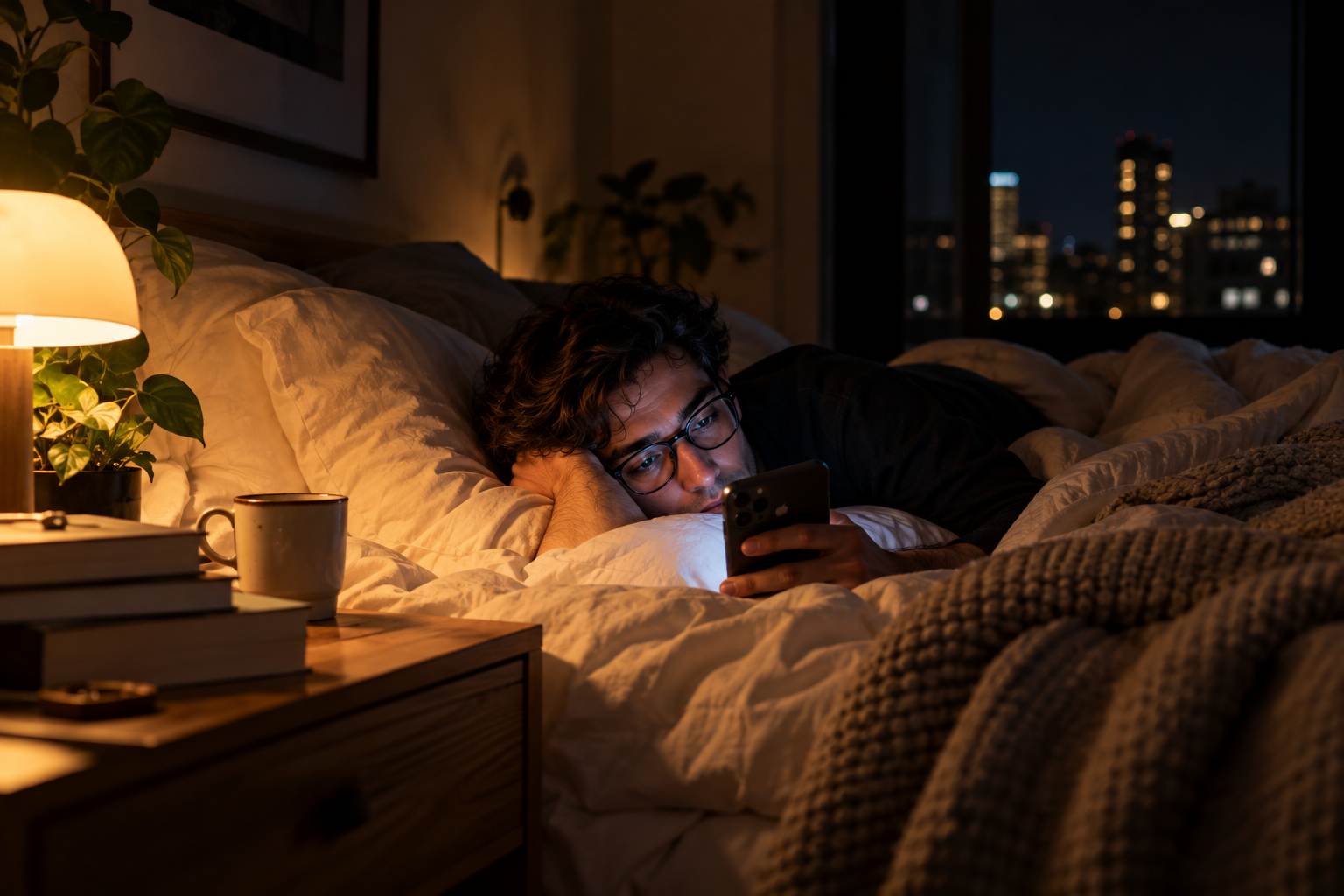
“Bedtime procrastination is defined as the volitional delay of going to bed, without any external circumstances causing the delay.”
– Hill et al., Sleep Medicine Reviews, 2022
It is 11:47 p.m. You are tired. Tomorrow starts early. Nothing important is happening on your phone, yet you keep postponing sleep. If you are wondering how to stop revenge bedtime procrastination, that small nightly decision is where to begin.
You keep scrolling anyway.
Revenge bedtime procrastination is the popular name for this strange trade: sacrificing tomorrow’s sleep to reclaim a piece of tonight.
The Clinical Research Uses a Simpler Term
Researchers more often study bedtime procrastination, defined as delaying bedtime without an external circumstance forcing the delay.
A 2022 systematic review and meta-analysis of 43 studies found that bedtime procrastination was associated with shorter sleep duration, worse sleep quality, greater daytime fatigue, lower self-control, and evening chronotype.
The evidence quality was low, and most studies were observational. That matters because association does not tell us one universal cause.
Where the “Revenge” Idea Comes In
The revenge framing adds a proposed motive: the person feels that the day did not contain enough time that belonged to them, so late evening becomes protected personal territory.
That motive is plausible, but it should not be assumed in every case.
A 2026 study of military service members found that greater role overload was associated with more revenge bedtime procrastination and worse functional outcomes. The design was cross-sectional, so it cannot prove that overload causes the behavior, but it supports the autonomy-conflict interpretation in at least one demanding environment.
The Trade Behind Bedtime Procrastination
The behavior makes more sense when we stop treating it as irrational.
| What staying up gives you now | What it costs tomorrow |
|---|---|
| Unstructured personal time | Less sleep |
| Entertainment after obligations | More fatigue |
| A sense of autonomy | Less time available for sleep |
| Immediate reward | Delayed cost |
The asymmetry is the problem. The reward is experienced now. The cost belongs to your future self.
Why Revenge Bedtime Procrastination Is Hard to Stop
If bedtime procrastination were only a knowledge problem, sleep education would solve it.
Knowing that sleep matters does not necessarily make the stopping decision easier.
The harder issue is that bedtime is a transition away from something immediately rewarding. Phones, shows, games, reading, and quiet personal time all compete with an outcome whose reward is delayed until morning.
How to Stop Revenge Bedtime Procrastination Without Treating Bedtime as a Battle
To understand how to stop revenge bedtime procrastination, start by identifying what you are postponing and why. Delaying your bedtime, lying awake after trying to sleep, and staying up because somebody needs your care are different situations. The following suggestions concern a bedtime you could reasonably keep, but repeatedly postpone.
The planning exercise below has short-term trial evidence. Moving leisure earlier, preparing the evening, and changing phone placement are practical experiments, not established treatments for every form of sleep delay.
Bedtime procrastination and the need for personal time
If late evening is your only discretionary time, try protecting a small, finite activity earlier when your circumstances allow it: a chapter after dinner, a short walk, or an uninterrupted conversation. The aim is to notice whether deliberately chosen leisure feels different from an open-ended feed. This is Sapien’s proposed experiment, not proof that an earlier break will fix bedtime procrastination.
Some days leave no realistic room for this. Work schedules, caregiving, and financial pressure cannot always be rearranged with a better routine. In that situation, the constraint deserves attention rather than another instruction to be more disciplined.
Make the bedtime routine easier to start
A complicated routine creates more opportunities to delay. Prepare what you can earlier: clothes, alarms, medications, lights, charging, and the next day’s essentials.
Stop Revenge Bedtime Procrastination With a Clear Stopping Cue
Choose a stopping cue before you start: the end of one episode, an alarm before your bedtime routine, or a charging place away from the sofa. A cue can make your intended stopping point easier to notice; it does not compel you to follow it. Choose a setup that still lets you meet necessary responsibilities.
How to Stop Revenge Bedtime Procrastination With an If-Then Plan
Two randomized trials in university students found that mental contrasting with implementation intentions reduced self-reported bedtime delay over short follow-up periods. The method pairs a desired outcome with the obstacle that stands in its way, then connects that obstacle to a specific response.
A 2025 registered trial compared daily practice with a single initial exercise over one week. Participants practicing daily reported less delay. It did not establish durable benefits or show that a simple alarm is equivalent to the full exercise.
- Choose a feasible wish: start your bedtime routine at a time that gives you an adequate sleep opportunity.
- Picture the outcome: what would a less rushed, less tired morning make possible?
- Name your obstacle: for example, opening another video when the first one ends.
- Write an if-then plan: “If I reach the stopping cue and want another video, then I will put the phone on its charger and begin my routine.”
That is an adapted example, not a prescription. For a week, note your intended bedtime, actual bedtime, and main obstacle. Review the pattern rather than treating one difficult night as failure. The trials support short-term self-reported changes; they do not promise a cure for insomnia.
Do Not Diagnose Yourself From a Catchy Label
Revenge bedtime procrastination is not a formal psychiatric diagnosis.
Sleep delay can occur for many reasons, including work schedules, caregiving, insomnia, anxiety, circadian preference, environmental disruption, and other conditions. When sleep timing is part of the problem, Sapien’s guide to morning sunlight explains how early light can help anchor circadian timing.
The label is most useful when it accurately describes a voluntary delay, not when it replaces a broader sleep assessment. If you repeatedly cannot sleep despite making time for it, or sleepiness is affecting safety or daily functioning, seek a clinical assessment rather than assuming a motivational problem.
The Sapien Interpretation: Sleep Is Sometimes Competing With Freedom
Bedtime can mark the end of the only part of a day that feels self-directed. That possibility helps explain why another reminder about sleep may miss the point. It is a lens for understanding some nights, not a universal account of sleep delay.
That changes the question worth asking before choosing a strategy.
If a person’s day feels completely owned by work, caregiving, or obligation, asking for more discipline at night adds another demand to an already controlled day.
The Sapien framework is to work on both sides of the equation: give chosen leisure a place in the day where feasible, and give the evening a stopping point that protects sleep. The aim is not to make leisure less enjoyable or turn every break into another productivity task.
Evidence also sets a boundary around this interpretation. In the 2025 trial, autonomous goal motives were not associated with bedtime procrastination. That is a different question from having too little leisure, but it cautions against treating “freedom” as an established explanation for everyone.
That is why how to stop revenge bedtime procrastination may begin earlier than bedtime. Sometimes the fix is not a stricter night. It is a day with a little more room in it.
The Question to Ask at 11:47
Do you actually want what you are doing, or are you protecting the fact that nobody is telling you what to do?
The distinction gives you something useful to test: whether you need a better stopping plan, more deliberately chosen time, or help with a sleep problem that the label does not explain.
Read next: how fika turns a break into protected time for connection. It offers a cultural perspective on making room for a pause, rather than treating every spare minute as time to fill.
References
- Hill VM, et al. Go to bed! A systematic review and meta-analysis of bedtime procrastination correlates and sleep outcomes. 2022.
- Kroese FM, et al. Bedtime procrastination: A self-regulation perspective on sleep insufficiency in the general population. Journal of Health Psychology. 2016;21(5):853-862. Published online 2014.
- The Characterization of Revenge Bedtime Procrastination in Military Servicemembers. 2026.
- Valshtein TJ, Oettingen G, Gollwitzer PM. Using mental contrasting with implementation intentions to reduce bedtime procrastination: two randomised trials. Psychology & Health. 2020;35(3):275-301. Published online 2019.
- Sezer B, et al. An experimental investigation of daily mental contrasting with implementation intentions and goal motives in reducing bedtime procrastination: a registered report. Psychology & Health. Published online April 12, 2025.
