

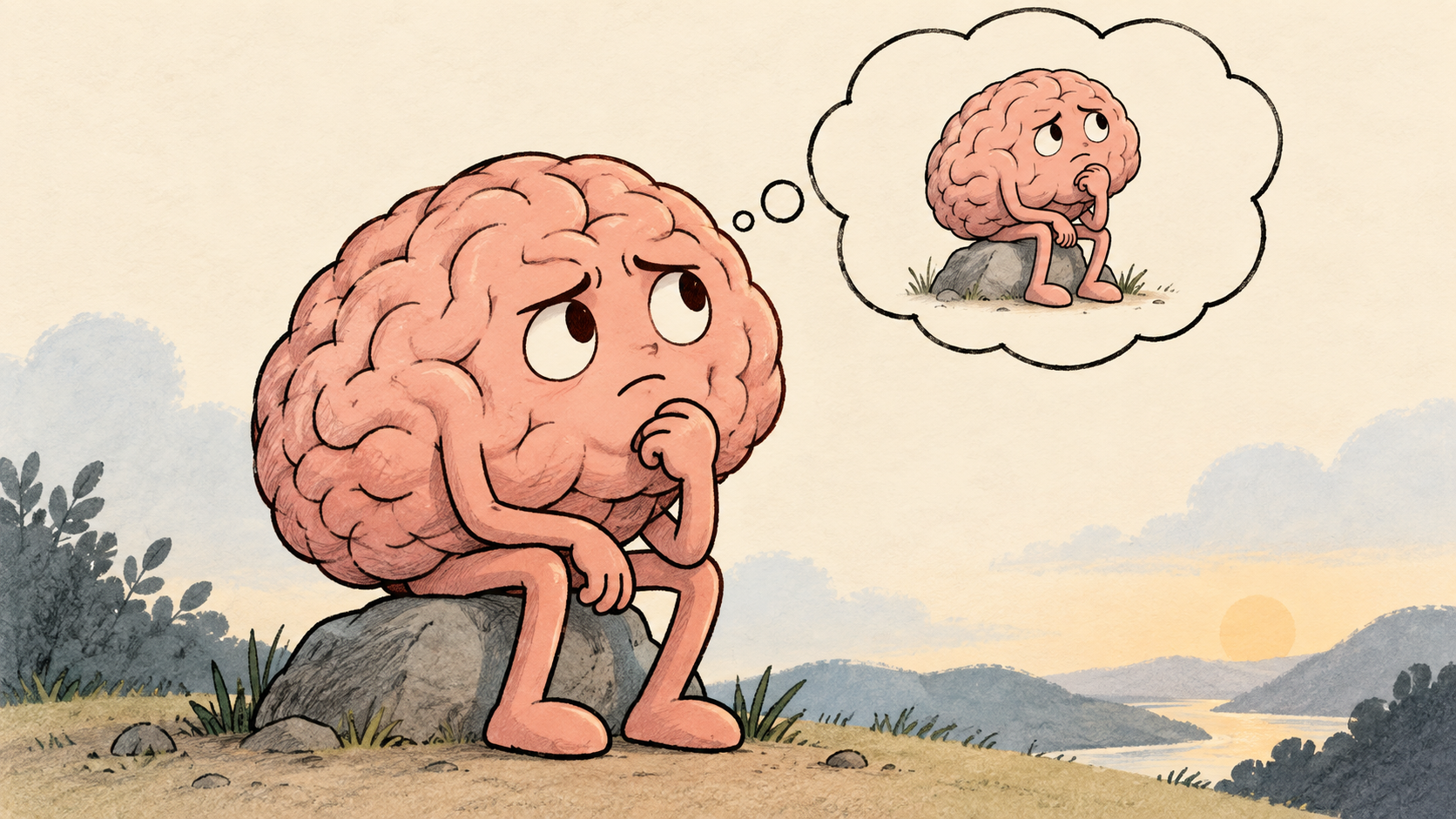
“We suffer more often in imagination than in reality.”
– Seneca, Moral Letters to Lucilius, Letter 13, c. 65 CE
When people ask how do you stop rumination, they are usually not asking how to stop thinking. They are asking how to tell when thinking has stopped helping.
That distinction matters. A difficult conversation may deserve reflection. A mistake may need analysis. A decision may require more information. But the same mental material can be revisited long after it has stopped producing anything new.
Rumination is not simply “thinking too much.” It is a repetitive process in which attention keeps returning to the same negative material without meaningfully changing the problem, the plan, or your understanding of what happened.
The goal, then, is not to eliminate difficult thoughts. It is to recognize the point where reflection becomes repetition and change the process before the loop keeps feeding itself.
Rumination Is a Process, Not a Diagnosis
Rumination usually refers to repetitive, self-focused thinking about distress, its causes, its meaning, or its consequences. It can appear in depression, anxiety, trauma-related conditions, and other clinical problems, but rumination itself is not a diagnosis.
Researchers increasingly study rumination alongside worry and other forms of repetitive negative thinking. A 2026 review of repetitive negative thinking describes ongoing debate about whether rumination and worry are best understood as separate processes or as related expressions of a broader transdiagnostic pattern.
That broader view is useful because the topic of the thought may matter less than what the mind is doing with it. One person may replay a conversation from yesterday. Another may imagine tomorrow going badly. In both cases, the mind can become locked into repetition that feels productive without actually moving toward resolution.
Rumination vs Reflection: How Do You Stop Rumination Without Stopping Useful Thought?
The boundary between reflection and rumination is not whether a thought is negative. Productive reflection can be painful. The more useful distinction is whether continued thinking creates informational gain.
| Process | What it tends to do | What changes |
|---|---|---|
| Reflection | Examines an experience to understand it | Your interpretation becomes clearer or more accurate |
| Problem solving | Defines a problem and evaluates possible responses | A decision, plan, or next action emerges |
| Rumination | Revisits the same distressing material repeatedly | Little changes except distress, urgency, or mental fatigue |
This is not a perfect diagnostic test. Reflection can become repetitive, and rumination can occasionally produce a useful insight. But the distinction is practical: productive thinking changes something. So how do you stop rumination without cutting off useful reflection? You watch for the point when thinking stops changing the problem, the plan, or your understanding.
Older experimental research found that induced rumination could worsen negative interpretations and reduce the quality of interpersonal problem solving in dysphoric participants. A broader 2020 review of rumination research similarly concluded that rumination can prolong negative mood, interfere with problem solving, reduce instrumental behavior, and make people less responsive to changing circumstances.
That helps explain why rumination vs problem solving is such an important distinction. Both involve thinking about a problem. Only one reliably moves the problem forward.
How Do You Stop Rumination When Thinking Still Feels Productive?
A useful way to identify the transition is to ask whether another round of thinking is changing one of three things.
Is the problem changing?
Maybe new facts have appeared. Perhaps you remembered something important, received new information, or realized that you misunderstood what happened. In that case, reflection still has new material to work with.
Is the plan changing?
Useful thinking often ends in a choice. You decide to apologize, ask a question, gather more information, wait until morning, schedule an appointment, change a habit, or accept that no action is currently available.
Is your understanding changing?
Reflection can also be useful without producing immediate action. You may recognize why something hurt, notice a pattern in your behavior, or revise an assumption.
If the problem, the plan, and your understanding are all unchanged, continued thinking may no longer be analysis. It may be repetition. At that point, how do you stop rumination? Not by forcing the thought away, but by changing what you do with it.
Why the Rumination Cycle Keeps Restarting
The rumination cycle is difficult to interrupt because the mind rarely labels it as useless. It usually feels unfinished.
One reason is uncertainty. A social interaction may not have a definitive explanation. A rejection may never come with a satisfying reason. A mistake cannot always be reversed. Rumination promises that one more pass through the evidence might finally produce certainty.
Another reason is abstraction. Questions such as “Why am I like this?” or “Why does this always happen?” are almost impossible to finish. They are broad enough to generate more thought indefinitely. More concrete questions, such as “What happened?” or “What can I do next?”, create a natural endpoint.
Cognitive control may also matter. A meta-analysis of 94 studies found that repetitive negative thinking was associated with difficulty discarding information that was no longer relevant from working memory. The association was modest, but it supports a useful idea: sometimes the problem is not generating a new thought. It is disengaging from an old one.
Context matters too. Certain places, times of day, behaviors, and cues can make the loop easier to restart. A silent commute, lying awake in bed, reopening a message thread, or scrolling through emotionally charged content can repeatedly return attention to the same material. Sapien’s article on enclothed cognition explores a different psychological phenomenon, but it makes a related point: cognition does not occur in isolation from context.
How Do You Stop Rumination? Interrupt the Process, Not the Thought
If the problem is repetition, the intervention should change what happens next rather than demand that the thought disappear. Learning how to stop rumination is therefore less about thought control and more about changing the operation the mind is performing.
| If the loop is doing this… | Change the process by… |
|---|---|
| Repeating an abstract “why?” question | Convert it into a concrete question about facts, options, or next actions |
| Searching for certainty that is unavailable | Define what is known, what is unknown, and what cannot be resolved right now |
| Rehearsing the same conclusion | Test the conclusion against evidence rather than repeating it |
| Keeping attention locked on the same material | Shift into a task that requires active attention or physical engagement |
| Reopening a solved problem because discomfort returned | Return only if new information or a new decision is available |
This is the central answer to how to break the rumination cycle: do not make the mind win an argument before you are allowed to move on. Change the operation.
How Do You Stop Rumination? What the Evidence Supports
Clinical research does not identify one universal technique that stops rumination for everyone. So how do you stop rumination according to the intervention literature? The strongest approaches tend to target the process of repetitive negative thinking rather than promise immediate control over thought content.
Cognitive behavioral approaches
A 2025 meta-analysis of 55 randomized controlled studies involving 4,970 participants found that cognitive behavioral interventions produced a moderate reduction in repetitive negative thinking compared with control conditions. Interventions that specifically targeted repetitive negative thinking had larger effects than less specific CBT approaches.
A separate 2024 systematic review of rumination-focused CBT found preliminary evidence that the approach can reduce rumination and depressive symptoms, while also emphasizing that stronger trials are still needed.
The important idea is not that every thought must be challenged. Process-focused approaches often ask whether the person is thinking abstractly or concretely, repeatedly analyzing causes, avoiding action, or using rumination as a response to mood.
Mindfulness and decentering
Mindfulness-based approaches take a different route. Instead of proving the thought wrong, they aim to change the relationship with the thought.
A 2025 systematic review and meta-analysis of 29 randomized trials involving 2,535 participants found that mindfulness-based cognitive therapy reduced rumination and improved related measures including decentering. Earlier meta-analytic work has reached similar conclusions, although study populations and interventions vary.
In practical terms, decentering means noticing “I am having this thought again” rather than immediately entering the thought as if it were a problem that must be solved now.
Behavior can end what analysis cannot
Sometimes the most important shift is behavioral. Rumination often narrows activity: people sit, withdraw, postpone, scroll, or continue analyzing. Action introduces new information that thought alone cannot provide.
That does not mean exercise, distraction, or activity is a cure for rumination. It means behavior can be the correct next step once thinking has stopped generating useful information.
Overthinking vs Rumination
Overthinking is an everyday term, not a precise psychological construct. People may use it to describe indecision, worry, excessive planning, perfectionism, rumination, or simply spending too much time on a choice.
Rumination is more specific. It usually refers to repetitive thinking about distress, causes, meanings, or consequences that becomes difficult to disengage from.
So not all overthinking is rumination. You can overanalyze which laptop to buy without entering a negative self-focused loop. You can also ruminate for hours about a brief social interaction while making no decision at all.
How Do You Stop Rumination? What Keeps the Cycle Alive
Demanding certainty can turn an unanswered question into a permanent mental project. Some situations simply do not provide enough information for certainty.
Repeated reassurance may reduce anxiety temporarily while making the original question feel important enough to revisit again.
Thought suppression can make a thought more salient. Trying to force the mind not to produce a thought is different from choosing not to keep analyzing it.
Unstructured journaling can also become rumination on paper if every entry retells the same story without generating a clearer interpretation, decision, or next step.
Waiting to feel resolved before acting keeps behavior dependent on a mental state that may never arrive. Sometimes action has to come before emotional closure. This is why how do you stop rumination is often a question about when to stop analyzing and let action, time, or uncertainty take over.
The Sapien Interpretation: The Informational Gain Rule
Rumination is difficult because it wears the clothing of serious thought. It feels responsible to keep examining something that matters.
The useful distinction is not how long you have been thinking or how painful the topic is. It is whether another round of thought is still generating informational gain.
Productive reflection earns more time when it changes at least one of three things: the problem, the plan, or your understanding. New facts change the problem. A decision changes the plan. A genuine insight changes your understanding.
When none of those changes, thinking may have completed its job even if the emotion has not completed its own.
That is the uncomfortable part. The mind often wants certainty, relief, or emotional closure before it agrees to stop. But thinking is not always capable of producing those states. Sometimes the mature move is to stop asking thought to do work that only time, action, conversation, or acceptance can do.
How Do You Stop Rumination When the Loop Returns?
When you notice the same material returning, ask:
- What new information appeared since the last time I thought about this?
- Is there a new decision available?
- Has my understanding actually changed?
If the answer to all three is no, you probably do not need another round of analysis right now.
You may still feel upset. The thought may return. That does not mean the thinking needs to restart.
When Rumination Needs More Than Self-Help
Persistent rumination can occur alongside depression, anxiety disorders, obsessive-compulsive symptoms, trauma-related conditions, insomnia, and other mental-health problems. Rumination alone does not establish any diagnosis.
If repetitive thinking is consuming large parts of the day, significantly disrupting sleep or work, worsening depression or anxiety, driving compulsive behavior, or becoming difficult to control, professional evaluation may be appropriate. Treatment should address the broader clinical picture rather than assuming every repetitive thought has the same cause.
References
- Stenzel KL, Keller J, Kirchner L, Rief W, Berg M. Efficacy of cognitive behavioral therapy in treating repetitive negative thinking, rumination, and worry: a transdiagnostic meta-analysis. Psychological Medicine. 2025.
- Watkins ER, Roberts H. Reflecting on rumination: Consequences, causes, mechanisms and treatment of rumination. Behaviour Research and Therapy. 2020.
- Li Y, Tang C. A systematic review of the effects of rumination-focused cognitive behavioral therapy in reducing depressive symptoms. 2024.
- The effectiveness of mindfulness-based cognitive therapy on rumination and related psychological indicators: a systematic review and meta-analysis. 2025.
- Zetsche U, et al. Shedding light on the association between repetitive negative thinking and deficits in cognitive control: a meta-analysis. 2018.
- Lyubomirsky S, Nolen-Hoeksema S. Effects of self-focused rumination on negative thinking and interpersonal problem solving. Journal of Personality and Social Psychology. 1995.
- Aberback R, Ashbaugh AR. Cracking the Repetitive Negative Thinking Code: Keys to Understanding Anxiety and Depression. Journal of Cognitive Psychotherapy. 2026.
